ƯU ĐÃI 18% HỌC PHÍ KHÓA LUYỆN THI IELTS

CAM KẾT ĐẦU RA 6.5+, COACHING 1-1 CÙNG CHUYÊN GIA

ƯU ĐÃI 18% HỌC PHÍ KHÓA IELTS, CAM KẾT ĐẦU RA 6.5+

Bộ đề dự đoán IELTS Speaking Part 2, Part 3 Quý 3 năm 2025

Trong bài viết này, Langmaster gửi đến bạn bộ đề dự đoán IELTS Speaking Part 2 và Part 3 cho Quý 3 năm 2025 (từ tháng 9 đến tháng 12). Đây là những câu hỏi có khả năng cao xuất hiện trong đề thi thật, kèm theo một số bài mẫu chất lượng cao giúp bạn dễ dàng luyện tập, mở rộng ý tưởng và cải thiện khả năng nói. Hãy cùng Langmaster ôn tập và sẵn sàng chinh phục kỳ thi IELTS nhé!

1. Tổng hợp đề thi IELTS Speaking Part 2, Part 3 Quý 3 năm 2025

Part 2: Describe a book you read that you found useful

You should say:

  • What it is
  • When you read it
  • Why you think it is useful

And explain how you felt about it

Part 3

  • What are the types of books that young people like to read?
  • What should the government do to make libraries better?
  • Do you think old people spend more time reading than young people?
  • Which one is better, paper books or e-books?
  • Have libraries changed a lot with the development of the internet?
  • What should we do to prevent modern libraries from closing down?

Part 2: Describe a popular person

You should say:

  • Who this person is
  • What kind of person he or she is
  • When you see him/her normally

And explain why you think this person is popular

Part 3

  • Why are some students popular in school?
  • Is it important for a teacher to be popular?
  • Do you think good teachers are always popular among students?
  • What are the qualities of being a good teacher?
  • Is it easier to become popular nowadays?
  • Why do people want to be popular?

>> Xem thêm: IELTS Speaking Part 3 Topic Reading Books

Part 2: Describe a creative person (e.g. an artist, a musician, an architect, etc.) you admire

You should say:

  • Who he/she is
  • How you knew him/her
  • What his/her greatest achievement is

And explain why you think he/she is creative

Part 3

  • Do you think children should learn to play musical instruments?
  • How do artists acquire inspiration?
  • Do you think pictures and videos in news reports are important?
  • What can we do to help children stay creative?
  • How does drawing help to enhance children’s creativity?
  • What kind of jobs require creativity?

>> Xem thêm: Topic Old Person IELTS Speaking Part 1, 2: Bài mẫu và từ vựng

Part 2:  Describe a long journey you had and would like to take again

You should say:

  • When/where you went
  • Who you had the journey with
  • Why you had the journey

And explain why you would like to have it again

Part 3

  • Do you think it is a good choice to travel by plane?
  • What are the differences between group travelling and travelling alone?
  • What do we need to prepare for a long journey?
  • Why do some people like making long journeys?
  • Why do some people prefer to travel in their own country?
  • Why do some people prefer to travel abroad?

Part 2:  Describe a person you know who enjoys working for a family business

You should say:

  • Who he/she is
  • What the business is
  • What his/her job is

And explain why he/she enjoys working there

Part 3

  • Would you like to start a family business?
  • Would you like to work for a family business?
  • Why do some people choose to start their own company?
  • What are the advantages and disadvantages of family businesses?
  • What family businesses do you know in your local area?
  • What makes a successful family business?

Part 2:  Describe a wild animal that you want to learn more about

You should say:

  • What it is
  • When/where you saw it
  • Why you want to learn more about it

And explain what you want to learn more about it

Part 3

  • Why should we protect wild animals?
  • Why are some people more willing to protect wild animals than others?
  • Do you think it’s important to take children to the zoo to see animals?
  • Why do some people attach more importance to protecting rare animals?
  • Should people educate children to protect wild animals?
  • Is it more important to protect wild animals or the environment?

>> Xem thêm: IELTS Speaking Topic Animal: Từ vựng & Bài mẫu Part 1, 2, 3

Part 2:  Describe a time when you broke something

You should say:

  • What it was
  • When/where that happened
  • How you broke it

And explain what you did after that

Part 3

  • What kind of things are more likely to be broken by people at home?
  • What kind of people like to fix things by themselves?
  • Do you think clothes produced in the factory are of better quality than those made by hand?
  • Do you think handmade clothes are more valuable?
  • Is the older generation better at fixing things?
  • Do you think elderly people should teach young people how to fix things?

Part 2: Describe an important old thing that your family has kept for a long time

You should say:

  • What it is
  • How/when your family first got this thing
  • How long your family has kept it

And explain why this thing is important to your family

Part 3

  • What kind of old things do people in your country like to keep?
  • Why do people keep old things?
  • What are the differences between the things old people keep and those young people keep?
  • What are the differences between the things that people keep today and the things that people kept in the past?
  • What can we see in a museum?
  • What can we learn from a museum?

Part 2:  Describe a good friend who is important to you

You should say:

  • Who he/she is
  • How/where you got to know him/her
  • How long you have known each other

And explain why he/she is important to you

Part 3

  • How do children make friends at school?
  • How do children make friends when they are not at school?
  • Do you think it is better for children to have a few close friends or many casual friends?
  • Do you think a child’s relationship with friends can be replaced by that with other people, like parents or other
  • family members?
  • What are the differences between friends made inside and outside the workplace?
  • Do you think it’s possible for bosses and their employees to become friends?

Part 2:  Describe a friend of yours who is good at music/singing

You should say:

  • Who he/she is
  • When/where you listen to his/her music/singing
  • What kind of music/songs he/she is good at

And explain how you feel when listening to his music/singing

Part 3

  • What kind of music is popular in your country?
  • What kind of music do young people like?
  • What are the differences between young people’s and old people’s preferences in music?
  • What are the benefits of children learning a musical instrument?
  • Do you know what kind of music children like today?
  • Do you think the government should invest more money in concerts?

Part 2:  Describe a great dinner you and your friends or family members enjoyed

You should say:

  • What you had
  • Who you had the dinner with
  • What you talked about during the dinner

And explain why you enjoyed it

Part 3

  • Do people prefer to eat out at restaurants or eat at home during the Spring Festival?
  • What food do you eat on special occasions, like during the Spring Festival or the Mid-autumn Festival?
  • Why do people like to have meals together during important festivals?
  • Is it a hassle to prepare a meal at home?
  • What do people often talk about during meals?
  • People are spending less and less time having meals with their families these days. Is this good or bad?

Part 2:  Describe an important decision you made with the help of other people

You should say:

  • What the decision was
  • Why you made the decision
  • Who helped you make the decision
  • And how you felt about it

Part 3

  • What kind of decisions do you think are meaningful?
  • What important decisions should be made by teenagers themselves?
  • Why are some people unwilling to make quick decisions?
  • Do people like to ask for advice more for their personal life or their work?
  • Why do some people like to ask others for advice?

Part 2:  Describe a time when the electricity suddenly went off

You should say:

  • When/where it happened
  • How long it lasted
  • What you did during that time

And explain how you felt about it

Part 3

  • Which is better, electric bicycles or ordinary bicycles?
  • Do you think electric bicycles will replace ordinary bicycles in the future?
  • Which is better, electric cars or petrol cars?
  • How did people manage to live without electricity in the ancient world?
  • Is it difficult for the government to replace all the petrol cars with electric cars?
  • Do people use more electricity now than before?

Part 2:  Describe an exciting activity you have tried for the first time

You should say:

  • What it is
  • When/where you did it
  • Why you thought it was exciting

And explain how you felt about it

Part 3

  • Why are some people unwilling to try new things?
  • Do you think fear stops people from trying new things?
  • Why are some people keen on doing dangerous activities?
  • Do you think that children adapt to new things more easily than adults?
  • What can people learn from doing dangerous activities?
  • What are the benefits of trying new things?

Part 2:  Describe an interesting traditional story

You should say:

  • What the story is about
  • When/how you knew it
  • Who told you the story

And explain how you felt when you first heard it

Part 3

  • What kind of stories do children like?
  • What are the benefits of listening to stories before bed?
  • Why do most children like listening to stories before bedtime?
  • What can children learn from stories?
  • Do all stories for children have happy endings?
  • Is a good storyline important for a movie?

Part 2:  Describe a place with a lot of trees that you would like to visit (for example, a forest or an oasis)

You should say:

  • Where it is
  • How you knew this place
  • What it is like

And explain why you would like to visit it

Part 3

  • Are natural views better than city views?
  • Do all people need some nature?
  • Are people hard-wired to protect the environment?
  • Why do people like visiting places with trees or forests?
  • Why is it important to have parks in the city?
  • What benefits can a park bring to a city?

>> Xem thêm: IELTS Speaking Part 2 Describe a place: Cách trả lời & từ vựng ăn điểm

Part 2:  Describe a natural talent (sports, music, etc.) you want to improve

You should say:

  • What it is
  • When you discovered it
  • How you want to improve it

And how you feel about it

Part 3

  • Do you think artists with talents should focus on their talents?
  • Is it possible for us to know whether children who are 3 or 4 years old will become musicians and painters when they grow up?
  • Why do people like to watch talent shows?
  • Do you think it is more interesting to watch famous people’s or ordinary people’s shows?

Part 2:  Describe a time when you told your friend an important truth

You should say:

  • Who your friend is
  • What the truth was
  • What your friend’s reaction was

And explain why you think it was important to tell your friend the truth

Part 3

  • Do you think we should tell the truth at all times?
  • How do you know when others are telling lies?
  • Sometimes people should tell lies. Do you agree?
  • Do you think it’s more important to win a game or follow the rules in sports?

Part 2:  Describe an occasion when you lost your way

You should say:

  • Where you were
  • What happened
  • How you felt

And explain how you found your way

Part 3

  • Is a paper map still necessary?
  • How do people react when they get lost?
  • Why do some people get lost more easily than others?
  • Do you think it is important to be able to read a map?
  • Do you think it is important to do some preparation before you travel to new places?
  • How can people find their way when they are lost?

Part 2:  Describe a quiet place you like to go

You should say:

  • Where it is
  • How you knew it
  • How often you go there
  • What you do there

And explain how you feel about the place

Part 3

  • Is it easy to find quiet places in your country? Why?
  • How do people spend their leisure time in your country?
  • How does technology affect the way people spend their leisure time?
  • Do you think only old people have time for leisure?
  • Why do old people prefer to live in quiet places?
  • Why are there more noises made at home now than in the past?

Part 2:  Describe an old person who has an interesting life and you enjoy talking to him/her

You should say:

  • Who this person is
  • Where he/she lives
  • What his/her life is like
  • What you like to talk about with him/her

And explain why you enjoy talking to him/her

Part 3

  • Should companies employ older workers?
  • What do you think older people can contribute at work?
  • Why do governments make retirement policies?
  • When do you think is the best time to retire?
  • Do you think people should spend more time with their grandparents?
  • Is it beneficial to live with elderly people?

Part 2:  Describe a time when you saw something in the sky (for example, flying kites, birds, a sunset, etc.)

You should say:

  • What you saw
  • Where/when you saw it
  • How long you saw it

And explain how you felt about the experience

Part 3

  • Would people be willing to get up early to watch and enjoy the sunrise?
  • When would people watch the sky?
  • Do many people pay attention to the shapes of stars?
  • What do people usually see in the sky in the daytime?
  • What are the differences between things people see in the sky in the daytime and at night?
  • Why do some people like to watch stars at night?

Part 2:  Describe a sport event that you would like to attend as part of the audience

You should say:

  • What it is
  • Who you want to watch with
  • Why you want to be part of the audience

And explain how you feel about it

Part 3

  • What kinds of sports events are broadcast on TV or other media in your country?
  • Do people in your country enjoy watching football games?
  • Do encouragement and applause from the audience have an impact on athletes? How do these affect them?
  • Which do people in your country prefer to watch, team sports or individual sports?
  • What kinds of sports are the most popular in your country?
  • Why do so many children like to watch basketball games?

Part 2:  Describe a place you went to and an outdoor activity you did there

You should say:

  • Where it was
  • When you went there
  • What outdoor activity you did there
  • Why you went there and did the activity

And explain how you felt about it

Part 3

  • What sports do young people like?
  • What kind of people do extreme sports?
  • Why are some people willing to try dangerous extreme sports?
  • Should people take more into account the risks that extreme sports may bring?
  • Why do people keep inventing new and slightly dangerous sports?
  • What risks are there in extreme sports, and who takes these consequences?

Part 2:  Describe an outdoor sport you would like to try for the first time

You should say:

  • What it is
  • When/where you would like to do it
  • With whom you would like to do it

And explain why you would like to do it

Part 3

  • What are the differences between indoor sports and outdoor sports?
  • What outdoor sports are popular in Vietnam?
  • What sports are popular among elderly people?
  • Which outdoor sports are popular with children?
  • How does weather affect outdoor sports?
  • Which is more dangerous, team sports or individual sports?

Part 2:  Describe a place where you saw many animals

You should say:

  • When you went there
  • Who you went with
  • What animals you saw there

And explain how you felt about the place

Part 3

  • Why do stories and movies for children always feature animals?
  • How did animals help people in the past?
  • Do you think people are more interested in animals now than they were in the past?
  • How do animals help us today?
  • Why should we protect animals?
  • Do you think children love animals more than old people do?

Part 2:  Describe an advertisement you have seen that introduced a well-known product

You should say:

  • When and where you saw the advertisement
  • What the product was
  • How you liked the advertisement

And explain how you felt about it

Part 3

  • Where do we often see advertisements?
  • What are the benefits of advertising?
  • Are advertisements good or bad for children?
  • How does advertising affect people?
  • Do people pay attention to advertisements on public transport?
  • Do you think it is good to see the same advertisements everywhere?

>> Xem thêm: Topic Advertisement IELTS Speaking Part 3: Bài mẫu, từ vựng

Part 2:  Describe a time when a person persuaded you to do something and you were happy about that

You should say:

  • Who he/she was
  • When/where it happened
  • What he/she persuaded you to do

And explain why you were happy

Part 3

  • What impact does advertising have on children and their parents?
  • What do parents often persuade their children to do?
  • Who do children listen to more, their parents or their teachers? Why?
  • What are some good ways to persuade children?
  • What advice should young people follow?
  • How do advertisements persuade people?

Part 2:  Describe a website that sells second-hand items

You should say:

  • What it is
  • How you found out about it
  • What people can buy from it

And explain whether you like it

Part 3

  • Some people think it’s a waste to buy too many clothes for children. What do you think?
  • What do people do with the clothes they don’t want anymore?
  • Why do people buy second-hand clothes?
  • What problems will occur if people don’t recycle?
  • Should the government encourage people to recycle items?
  • How do people in your country recycle various items they don’t want?

Part 2:  Describe a time when you and some other people made a plan to do an activity

You should say:

  • What it was
  • When and where you made it
  • What the activity was

And explain how you felt about the plan

Part 3

  • What kind of plans do young people often make?
  • Why can’t people always follow their plans?
  • Why do people make plans?
  • Is it important to make plans?
  • Why do some people like to make plans while others just don’t like to?
  • Are there any people who never make plans?

Part 2:  Describe a person from a different cultural background with whom you enjoy spending time

You should say:

  • Who he/she is
  • Where he/she is from
  • Where/how you knew him/her

And explain how you feel about him/her

Part 3

  • Is it easy to meet people from different cultural backgrounds in your country?
  • What do people from different cultural backgrounds usually talk about with each other?
  • Is it good to live in a multicultural society?
  • What are the advantages of being friends with people from different cultural backgrounds?
  • Why do people choose to travel or live abroad?
  • What are the benefits of living in another country?

Part 2:  Describe a city that you have been to and would like to visit again

You should say:

  • When you visited it
  • What you did there
  • What it was like

And explain why you would like to visit it again

Part 3

  • What’s the difference between the city and the countryside?
  • Some people say large cities are suitable for old people. What do you think?
  • Do you think it is possible that all of the population move to cities?
  • Do you think people in the countryside are friendlier than people in the city?
  • Are there any changes in your city?
  • What should the government do to improve citizens’ safety?

Part 2:  Describe a shop/store you enjoy visiting

You should say:

  • What the shop’s name is
  • Where it is
  • How often you visit it

And explain why you like to visit it

Part 3

  • Do people in your country go to the shopping mall frequently?
  • How have people’s shopping habits changed in recent decades?
  • Do you think shops and shopping malls will disappear in the future?
  • What are the differences between shopping in street markets and big shopping malls?
  • What are the differences in the shopping habits of different age groups?
  • What are the differences between shopping online and in-store?

Part 2:  Describe a person you disliked at first but ended up being friends with

You should say:

  • Who he/she is
  • How you knew him/her
  • Why you disliked him/her at first but changed your mind

And explain how you feel about the experience

Part 3

  • What do you think of making friends online?
  • Is it a good idea to make friends with people who are much older than you?
  • Do you enjoy meeting new people?
  • Do you think friendship is important?
  • Why is it difficult for some people to make friends with others?
  • Do we benefit from having friends with different personalities?

Part 2:  Describe an impressive conversation you had that you remember well

You should say:

  • Who you talked to
  • When and where you had it
  • What you talked about

And explain why you think it was impressive

Part 3

  • Today, what is the most popular way to communicate?
  • Do people communicate more when they talk face to face?
  • Do you think nowadays texting is the most popular method of communication among young people?
  • Are communication skills important at work?
  • What conversations do young people normally have?
  • What topics do young people usually talk about?
  • Why do some people communicate more effectively than others?
  • Do you think we need to be good at communication at work?
  • What’s the difference between face-to-face conversations and phone conversations?
  • Are there any disadvantages of face-to-face conversations?
  • What kinds of communication skills are important?
  • What are the differences between talking with friends online and face-to-face?
  • What are the differences between online and onsite meetings in a company?

Part 2:  Describe a friend of yours who is well-dressed and is good at dressing up

You should say:

  • Who he/she is
  • How you knew him/her
  • What his/her dressing style is

And explain why he/she dresses this way

Part 3

  • Do most people in your country prefer to buy clothes online or at the street market? Why?
  • Do you think young people know more about fashion and are better at dressing up than elderly people?
  • Do you think people would use clothing to show their identity?
  • Why do many people prefer to buy rather expensive clothes?
  • What are the differences between cheap and expensive clothes?
  • Why do some people care so much about their clothing?

Part 2:  Describe an article on health you read in a magazine or on the Internet

You should say:

  • What it was
  • Where you read it
  • Why you read it

And how you felt about it

Part 3

  • Do you think people are healthier now than in the past?
  • How can you tell whether a website is reliable or not?
  • What activities can schools organize for children to keep fit?
  • What can governments do to improve people’s health?
  • How do today’s people keep healthy?
  • Is it difficult to keep healthy?
  • Where can people find information about keeping healthy?
  • Do schools have the responsibility to provide health education?
  • Is it hard for modern people to live a healthy lifestyle?
  • What can parents do to help improve their children's health awareness?

Part 2:  Describe an unusual but interesting building you would like to visit

You should say:

  • Where it is
  • What it looks like
  • Why you think it is unusual and interesting

And explain why you would like to visit it

Part 3

  • Do you think old buildings should be preserved?
  • Do you think a city’s buildings affect its vibe or atmosphere?
  • What factors do you consider when choosing a house or an apartment?
  • Why do some people choose to build houses by themselves?
  • How do people in your country feel about old buildings?

>> Xem thêm: Topic Old Buildings IELTS Speaking Part 1, 2, 3: Bài mẫu và từ vựng band 7+

Part 2: Describe a famous person you would like to meet

You should say:

  • Who he/she is
  • How you knew him/her
  • How/where you would like to meet him/her

And explain why you would like to meet him/her

Part 3

  • Do people become famous because of their talent?
  • What can children do with their fame?
  • What can today’s children do to become famous?
  • What are the advantages and disadvantages of being a famous child?

>> Xem thêm: IELTS Speaking Part 2: Describe a famous person in your country 

Part 2:  Describe something that you did with someone/a group of people

You should say:

  • What it was
  • Who you did it with
  • How long it took you to do this

And explain why you did it together

Part 3

  • How do you get along with your neighbors?
  • How do neighbors help each other?
  • Do you think neighbors help each other more often in the countryside than in the city?
  • How do children learn to cooperate with each other?
  • Do you think parents should teach children how to cooperate with others? How?
  • Do you think it’s important for children to learn about cooperation?

Part 2:  Describe a time when someone gave you something that you really wanted

You should say:

  • What it was
  • When you received it
  • Who gave it to you

And explain how you felt when the person gave it to you

Part 3

  • Do you think shopping is good for a country’s economy?
  • Why do people like shopping more now than in the past?
  • How should children spend their allowance money?
  • What kinds of gifts do young people like to receive as rewards?
  • How should bosses reward employees?
  • Should employees have their own goals?
  • What rewards can companies offer to outstanding employees?
  • What are the benefits and drawbacks of consumerism for a country's economy?

Part 2:  Describe your first day at school that you remember

You should say:

  • Where the school was
  • How you went there
  • What happened that day

And how you felt on that day

Part 3

  • What would parents prepare when their kids go to school on the first day?
  • How do children socialize with each other?
  • Is socialization important for children?
  • What are the reasons for job change?
  • Are big companies better than small companies? Why?
  • What are the advantages and disadvantages coming along with changing jobs?

Part 2:  Describe a piece of technology you own that you feel is difficult to use

You should say:

  • When you got it
  • What you got it for
  • How often you use it

And explain how you feel about it

Part 3

  • What technology do people currently use?
  • Why do big companies introduce new products frequently?
  • Why are people so keen on buying iPhones even though they haven’t changed much from one iPhone to the next?
  • Why do technology companies keep upgrading their products?
  • What changes has the development of technology brought about in our lives?
  • Does the development of technology affect the way we study? How?

>> Xem thêm: Topic Technology IELTS Speaking Part 3: Bài mẫu kèm từ vựng

Part 2:  Describe your favorite place in your house where you can relax

You should say:

  • Where it is
  • What it is like
  • What you enjoy doing there

And explain why you feel relaxed at this place

Part 3

  • Why is it difficult for some people to relax?
  • What are the benefits of doing exercise?
  • Do people in your country exercise after work?
  • What is the place where people spend most of their time at home?
  • Do you think there should be classes for training young people and children how to relax?
  • Which is more important, mental relaxation or physical relaxation?

Part 2:  Describe a person you have met who you want to work/study with

You should say:

  • Who this person is
  • How you met this person
  • How long you have known him/her

And explain why you want to work/study with him/her

Part 3

  • Why should children be kind to their classmates?
  • Can children choose their deskmates?
  • What matters most about a colleague’s personality?
  • Are good colleagues important at work?
  • What kind of people are popular at work?
  • Are knowledgeable people popular at work?
  • What are the characteristics that good co-workers need?
  • What benefits are there if you are surrounded by good co-workers?
  • What would happen if the co-workers are not good?

Part 2:  Describe a website you often visit

You should say:

  • What it is about
  • How you found out about it
  • How often you visit it

And explain why you often visit it

Part 3

  • What are the most popular and least popular apps in Vietnam?
  • What’s the difference between the internet and television?
  • Why do some people like to read the news on the internet instead of getting it from TV?
  • Is the library still necessary? Why?
  • What kinds of people would still go to the library to read and study?
  • What are the differences between old people and young people when they use the internet?
  • Will libraries be replaced by the Internet?

Part 2:  Describe a noisy place you have been to

You should say:

  • Where it is
  • When you went there
  • What you did there

And explain why you feel it’s a noisy place

Part 3

  • Do you think it is good for children to make noise?
  • Should children not be allowed to make noise under any circumstances?
  • What kinds of noises are there in our life?
  • Which area is exposed to noise more, the city or the countryside?
  • How would people usually respond to noises in your country?
  • How can people consider others’ feelings when chatting in public?
  • Are cities becoming noisier?
  • Do you mind noises?
  • Do any noises bother you?

Part 2:  Describe a person who inspired you to do something interesting

You should say:

  • Who he/she is
  • How you knew him/her
  • What interesting thing you did

And explain how he/she inspired you to do it

Part 3

  • What qualities make someone a role model?
  • Why should children learn from role models?
  • Who can influence children more, teachers or parents?
  • What kind of international news inspires people?
  • Besides parents and teachers, who else can motivate children?
  • Can online teaching motivate students to learn? How?
  • Which types of people become role models in your society?
  • Do you agree that famous people have more responsibilities than ordinary people?
  • What happens when young people lack good role models?

Part 2:  Describe a place in your country or part of your country that you would like to recommend to visitors/travelers

You should say:

  • What it is
  • Where it is
  • What people can do there

And explain why you would like to recommend it to visitors/travelers

Part 3

  • Is it important to take photos while traveling?
  • Can you trust other people’s travel journals on the Internet?
  • What factors affect how people feel about traveling?
  • Will you go to a foreign country to travel because of the distinct landscape?
  • How can tourists have a good travel experience?
  • What kinds of comments do travelers typically leave online after a trip?

Part 2:  Describe a time when you forgot/missed an appointment

You should say:

  • When it happened
  • What happened
  • Why you forgot or missed it

And explain how you felt about this experience

Part 3

  • How do people who are busy remember things they need to do?
  • Do you think people should remember family history?
  • What do you think of people using calendars to remind themselves of things?
  • Is punctuality important?
  • What do you think is a good way to record things?
  • Which is more important, a work-related appointment or an appointment with a friend?
  • If someone doesn’t really like whom they are going to meet, do you think they may deliberately miss their appointment?

2. Bài mẫu IELTS Speaking Part 2, Part 3 Quý 3 năm 2025

2.1. Describe a time when you told your friend an important truth

You should say:

  • Who your friend is
  • What the truth was
  • What your friend’s reaction was

And explain why you think it was important to tell your friend the truth

Bài mẫu: 

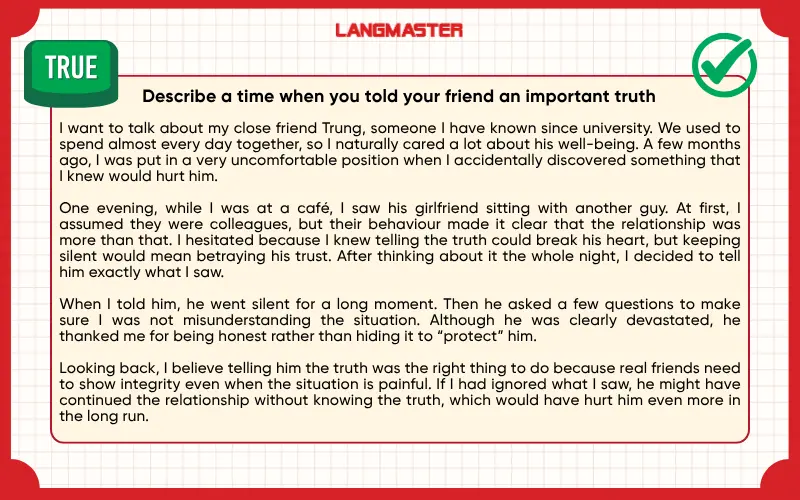
I want to talk about my close friend Trung, someone I have known since university. We used to spend almost every day together, so I naturally cared a lot about his well-being. A few months ago, I was put in a very uncomfortable position when I accidentally discovered something that I knew would hurt him.

(Tôi muốn kể về người bạn thân tên Trung, người mà tôi quen từ thời đại học. Chúng tôi gần như ngày nào cũng đi cùng nhau nên tôi rất quan tâm đến cảm xúc của cậu ấy. Vài tháng trước, tôi rơi vào một tình huống vô cùng khó xử khi vô tình phát hiện ra một điều mà tôi biết chắc sẽ khiến cậu ấy tổn thương.)

One evening, while I was at a café, I saw his girlfriend sitting with another guy. At first, I assumed they were colleagues, but their behaviour made it clear that the relationship was more than that. I hesitated because I knew telling the truth could break his heart, but keeping silent would mean betraying his trust. After thinking about it the whole night, I decided to tell him exactly what I saw.

(Một tối nọ khi tôi đang ở quán cà phê, tôi thấy bạn gái của cậu ấy ngồi với một người đàn ông khác. Ban đầu tôi nghĩ họ là đồng nghiệp, nhưng cách họ cư xử cho thấy mối quan hệ đó thân mật hơn nhiều. Tôi do dự vì biết nói ra có thể làm cậu ấy đau lòng, nhưng im lặng thì lại thành phản bội niềm tin của bạn mình. Sau cả đêm suy nghĩ, tôi quyết định nói cho cậu ấy biết chính xác điều tôi đã thấy.)

When I told him, he went silent for a long moment. Then he asked a few questions to make sure I was not misunderstanding the situation. Although he was clearly devastated, he thanked me for being honest rather than hiding it to “protect” him.

(Khi tôi kể lại, cậu ấy im lặng khá lâu. Sau đó cậu ấy hỏi lại vài câu để chắc chắn rằng tôi không hiểu lầm. Dù có thể thấy rõ cậu ấy rất đau, nhưng cậu ấy cảm ơn tôi vì đã trung thực thay vì giấu giếm để “bảo vệ” cậu ấy.)

Looking back, I believe telling him the truth was the right thing to do because real friends need to show integrity even when the situation is painful. If I had ignored what I saw, he might have continued the relationship without knowing the truth, which would have hurt him even more in the long run.

(Nghĩ lại, tôi tin rằng việc nói thật là lựa chọn đúng vì bạn bè thực sự phải giữ sự liêm chính ngay cả khi chuyện đó gây đau lòng. Nếu tôi làm ngơ, có lẽ cậu ấy đã tiếp tục mối quan hệ đó mà không biết gì, và điều đó sẽ khiến cậu ấy tổn thương nhiều hơn về lâu dài.)

PHÂN TÍCH TỪ VỰNG

  • devastated: suy sụp, đau đớn tột độ
    Ví dụ: She looked devastated after hearing the news.(Cô ấy trông suy sụp sau khi nghe tin.)
  • betray his trust: phản bội niềm tin
    Ví dụ: Lying to a close friend can easily betray their trust. (Nói dối bạn thân rất dễ làm phản bội niềm tin của họ.)
  • integrity: liêm chính, sự ngay thẳng
    Ví dụ: A good leader must act with integrity. (Một người lãnh đạo tốt phải hành xử với sự liêm chính.)
  • hesitated: do dự, lưỡng lự
    Ví dụ: He hesitated before answering the difficult question. (Anh ấy do dự trước khi trả lời câu hỏi khó.)
  • make sure: kiểm tra, xác nhận
    Ví dụ: Always make sure the information is correct before sharing it. (Hãy luôn xác nhận thông tin đúng trước khi chia sẻ.)
  • in the long run: về lâu dài
    Ví dụ: Saving money is helpful in the long run. (Tiết kiệm tiền có lợi về lâu dài.)
Describe a time when you told your friend an important truth ielts speaking part 2

>> Xem thêm: IELTS Speaking Part 2: Câu hỏi, cách trả lời và bài mẫu band 8+

Part 3 – Discussion Questions

Do you think we should tell the truth at all times?

To be honest, I do not think we should tell the truth at all times because honesty can sometimes do more harm than good. In certain situations, a gentle version of the truth helps protect someone’s emotions without completely hiding the facts. For example, when giving feedback, softening our words can prevent unnecessary embarrassment while still pointing them in the right direction.

Thật lòng mà nói, tôi không nghĩ rằng lúc nào cũng phải nói thật vì đôi khi sự thành thật lại gây tổn thương nhiều hơn lợi ích. Trong một số tình huống, một phiên bản nhẹ nhàng hơn của sự thật sẽ giúp bảo vệ cảm xúc của người khác mà không giấu đi bản chất sự việc. Chẳng hạn, khi góp ý, diễn đạt khéo hơn có thể tránh làm họ xấu hổ không cần thiết mà vẫn định hướng được vấn đề.

Phân tích từ vựng

  • do more harm than good (idiom): gây hại nhiều hơn lợi
    Ví dụ: Being too direct can sometimes do more harm than good. (Dịch: Quá thẳng thắn đôi khi gây hại nhiều hơn lợi.)
  • a gentle version of the truth: phiên bản nhẹ nhàng của sự thật
    Ví dụ: She chose a gentle version of the truth to avoid hurting her friend. (Dịch: Cô ấy chọn cách nói nhẹ nhàng hơn để tránh làm bạn tổn thương.)
  • softening our words: làm lời nói bớt nặng nề
    Ví dụ: Softening our words can make difficult conversations easier. (Dịch: Làm lời nói nhẹ nhàng hơn giúp những cuộc nói chuyện khó trở nên dễ dàng hơn.)
  • unnecessary embarrassment: sự bối rối không cần thiết
    Ví dụ: He tried to avoid causing unnecessary embarrassment during the meeting. (Dịch: Anh ấy cố tránh làm mọi người bối rối không cần thiết trong cuộc họp.)
  • point someone in the right direction: hướng ai đó đi đúng hướng
    Ví dụ: Her advice really pointed me in the right direction. (Dịch: Lời khuyên của cô ấy đã giúp tôi đi đúng hướng.)

Đăng ký test (đổi tạm của test TAGT)

How do you know when others are telling lies?

In my opinion, it is usually a mix of subtle behavioural cues that reveal whether someone is lying. People often avoid eye contact or give overly complicated explanations when they are hiding something. Moreover, their tone may shift slightly, especially when they feel pressured to keep their story consistent. Of course, these signs are not always accurate, but they can help us question whether the information we hear is genuinely reliable.

Theo tôi, thường là sự kết hợp của những dấu hiệu hành vi tinh tế cho thấy ai đó đang nói dối. Mọi người thường tránh nhìn thẳng hoặc giải thích quá dài dòng khi che giấu điều gì đó. Thêm vào đó, giọng nói của họ có thể thay đổi đôi chút, đặc biệt khi họ phải cố giữ câu chuyện nhất quán. Tất nhiên, những dấu hiệu này không phải lúc nào cũng chính xác, nhưng chúng giúp chúng ta xem xét liệu thông tin mình nghe có đáng tin hay không.

Phân tích từ vựng

  • subtle behavioural cues: dấu hiệu hành vi tinh tế
    Ví dụ: Subtle behavioural cues can reveal someone’s emotions. (Dịch: Những dấu hiệu hành vi tinh tế có thể cho thấy cảm xúc của ai đó.)
  • overly complicated explanations: lời giải thích phức tạp quá mức
    Ví dụ: He gave an overly complicated explanation and made everyone suspicious. (Dịch: Anh ấy đưa ra lời giải thích quá phức tạp khiến ai cũng nghi ngờ.)
  • shift in tone: thay đổi giọng điệu
    Ví dụ: A sudden shift in tone often signals discomfort. (Dịch: Một sự thay đổi giọng đột ngột thường báo hiệu sự khó chịu.)
  • keep their story consistent: giữ câu chuyện nhất quán
    Ví dụ: When people lie, they struggle to keep their story consistent. (Dịch: Khi nói dối, họ khó giữ câu chuyện nhất quán.)
  • genuinely reliable: thật sự đáng tin
    Ví dụ: Not all online information is genuinely reliable. (Dịch: Không phải thông tin trên mạng nào cũng thật sự đáng tin.)

Sometimes people should tell lies. Do you agree?

To some extent, I do agree because not all lies are harmful. In certain situations, a small lie can protect someone’s dignity or prevent unnecessary conflict. For instance, when comforting a friend who is already stressed, choosing kinder words rather than the harsh truth can be more supportive. Even so, these lies should be used with caution because relying on them too often may gradually undermine trust in a relationship.

Ở một mức độ nào đó, tôi đồng ý vì không phải lời nói dối nào cũng gây hại. Trong vài trường hợp, một lời nói dối nhỏ có thể giữ thể diện cho ai đó hoặc tránh xung đột không cần thiết. Ví dụ, khi an ủi người bạn đang căng thẳng, chọn những lời dễ nghe hơn thay vì sự thật khắc nghiệt đôi khi lại hỗ trợ họ tốt hơn. Dù vậy, những lời nói dối này cần được dùng cẩn trọng vì dùng quá nhiều có thể dần làm suy yếu niềm tin trong một mối quan hệ.

Phân tích từ vựng

  • protect someone’s dignity: giữ thể diện cho ai đó
    Ví dụ: He tried to protect her dignity by not mentioning the mistake. (Dịch: Anh ấy cố giữ thể diện cho cô ấy bằng cách không nhắc đến lỗi lầm.)
  • unnecessary conflict: mâu thuẫn không cần thiết
    Ví dụ: Clear communication helps avoid unnecessary conflict. (Dịch: Giao tiếp rõ ràng giúp tránh được mâu thuẫn không cần thiết.)
  • comforting a friend: an ủi một người bạn
    Ví dụ: Comforting a friend requires patience and empathy. (Dịch: An ủi bạn bè cần sự kiên nhẫn và đồng cảm.)
  • harsh truth: sự thật khắc nghiệt
    Ví dụ: The harsh truth can be difficult to accept. (Dịch: Sự thật khắc nghiệt đôi khi khó chấp nhận.)
  • undermine trust: làm suy yếu niềm tin
    Ví dụ: Repeated lies can undermine trust in a relationship. (Dịch: Những lời nói dối lặp lại có thể làm suy yếu niềm tin trong một mối quan hệ.)

>> Xem thêm: IELTS Speaking Part 3 kéo dài bao lâu? Thông tin cần biết về Part 3

2.2. Describe an impressive conversation you had that you remember well

You should say:

  • Who you talked to
  • When and where you had it
  • What you talked about

And explain why you think it was impressive

Describe an impressive conversation you had that you remember well ielts speaking part 2

Bài mẫu: 

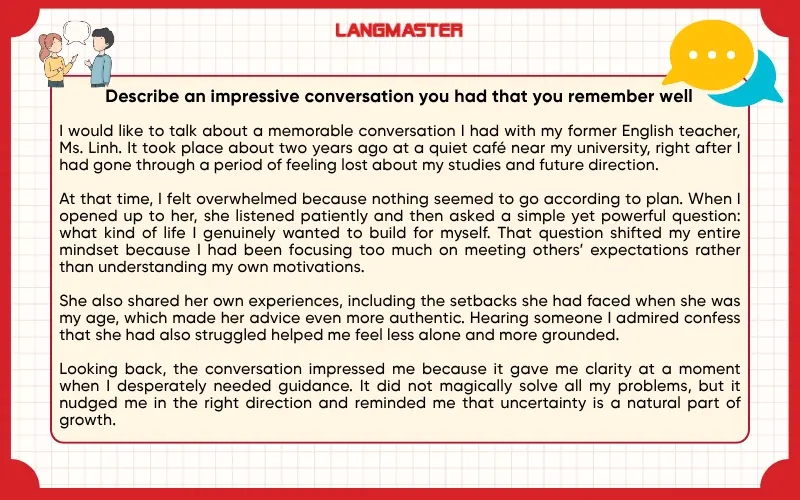
I would like to talk about a memorable conversation I had with my former English teacher, Ms. Linh. It took place about two years ago at a quiet café near my university, right after I had gone through a period of feeling lost about my studies and future direction.

(Tôi muốn kể về một cuộc trò chuyện đáng nhớ với cô giáo tiếng Anh cũ tên Linh. Cuộc trò chuyện diễn ra cách đây khoảng hai năm tại một quán cà phê yên tĩnh gần trường đại học của tôi, ngay sau khi tôi vừa trải qua giai đoạn thấy lạc hướng trong việc học và tương lai.)

At that time, I felt overwhelmed because nothing seemed to go according to plan. When I opened up to her, she listened patiently and then asked a simple yet powerful question: what kind of life I genuinely wanted to build for myself. That question shifted my entire mindset because I had been focusing too much on meeting others’ expectations rather than understanding my own motivations.

(Thời điểm đó tôi cảm thấy quá tải vì mọi thứ dường như không theo đúng kế hoạch. Khi tôi mở lòng với cô, cô lắng nghe rất kiên nhẫn rồi hỏi một câu đơn giản nhưng đầy sức nặng: tôi thực sự muốn xây dựng cuộc sống như thế nào cho chính mình. Câu hỏi đó khiến tôi thay đổi hoàn toàn cách suy nghĩ, bởi trước đó tôi chỉ cố đáp ứng kỳ vọng của người khác thay vì hiểu điều mình thật sự muốn.)

She also shared her own experiences, including the setbacks she had faced when she was my age, which made her advice even more authentic. Hearing someone I admired confess that she had also struggled helped me feel less alone and more grounded.

(Cô cũng chia sẻ những trải nghiệm của chính mình, bao gồm cả những lần thất bại khi cô bằng tuổi tôi, điều này khiến lời khuyên của cô trở nên chân thực hơn. Việc nghe một người mà tôi ngưỡng mộ thừa nhận rằng cô cũng từng gặp khó khăn giúp tôi cảm thấy bớt cô đơn và vững vàng hơn.)

Looking back, the conversation impressed me because it gave me clarity at a moment when I desperately needed guidance. It did not magically solve all my problems, but it nudged me in the right direction and reminded me that uncertainty is a natural part of growth.

(Nghĩ lại, cuộc trò chuyện khiến tôi ấn tượng vì nó mang lại sự sáng tỏ vào đúng thời điểm tôi thật sự cần sự định hướng. Nó không giải quyết ngay mọi vấn đề, nhưng giúp tôi đi đúng hướng và nhắc tôi rằng sự mơ hồ là điều tự nhiên trong quá trình trưởng thành.)

PHÂN TÍCH TỪ VỰNG

  • opened up: mở lòng chia sẻ
    Ví dụ: She finally opened up about her worries. (Dịch: Cô ấy cuối cùng cũng mở lòng về những nỗi lo.)
  • powerful question: câu hỏi có sức nặng
    Ví dụ: He asked a powerful question that made me rethink my choices. (Dịch: Anh ấy hỏi một câu có sức nặng khiến tôi suy nghĩ lại lựa chọn của mình.)
  • shifted my mindset: thay đổi tư duy
    Ví dụ: The book completely shifted my mindset about success. (Dịch: Cuốn sách đã thay đổi hoàn toàn cách tôi nhìn nhận về thành công.)
  • authentic: chân thật, đáng tin
    Ví dụ: Her advice felt authentic because she had lived through similar experiences. (Dịch: Lời khuyên của cô rất chân thật vì cô từng trải qua những điều tương tự.)
  • grounded: vững vàng, không bị mất phương hướng
    Ví dụ: Talking to him kept me grounded during a stressful time. (Dịch: Nói chuyện với anh ấy giúp tôi giữ được sự vững vàng trong thời điểm căng thẳng.)
  • nudged me in the right direction: hướng tôi đi đúng hướng
    Ví dụ: A small piece of advice nudged me in the right direction. (Dịch: Một lời khuyên nhỏ đã hướng tôi đi đúng hướng.)

Part 3 – Discussion Questions

What topics do young people like to talk about?

From my experience, young people usually enjoy talking about things that reflect their daily lives, such as relationships, personal goals and the latest trends on social media. Besides that, many of them are also interested in discussing career paths because they are trying to figure out what truly suits them. These conversations may seem casual at first, yet they often help young people understand themselves better and shape their decisions in a more thoughtful way.

Theo trải nghiệm của tôi, người trẻ thường thích nói về những điều gắn với cuộc sống hằng ngày như các mối quan hệ, mục tiêu cá nhân và những xu hướng mới trên mạng xã hội. Bên cạnh đó, nhiều người cũng quan tâm đến chuyện nghề nghiệp vì họ đang cố tìm xem điều gì phù hợp với mình. Những cuộc trò chuyện này thoạt nghe có vẻ bình thường nhưng lại giúp họ hiểu bản thân hơn và đưa ra quyết định một cách chín chắn hơn.

Phân tích từ vựng

  • latest trends: xu hướng mới nhất
    Ví dụ: Young people quickly follow the latest trends online. (Dịch: Người trẻ thường nhanh chóng theo các xu hướng mới trên mạng.)
  • figure out: tìm ra, hiểu ra
    Ví dụ: She is trying to figure out which major she should choose. (Dịch: Cô ấy đang cố tìm xem mình nên chọn ngành nào.)
  • casual conversations: cuộc trò chuyện bình thường
    Ví dụ: Casual conversations can unexpectedly give useful insights. (Dịch: Những cuộc trò chuyện bình thường đôi khi lại mang đến góc nhìn hữu ích.)
  • shape their decisions: định hình quyết định
    Ví dụ: Early experiences can shape their decisions later in life. (Dịch: Những trải nghiệm sớm có thể định hình quyết định sau này trong cuộc sống.)

Is it important to have good communication skills at work?

In my opinion, strong communication skills are essential at work because they prevent misunderstandings and help teams operate more efficiently. When colleagues can express their thoughts clearly, problems are solved much faster and everyone knows what they are responsible for. Moreover, good communication often creates a healthier work atmosphere, which boosts teamwork and overall productivity. Without it, even talented employees may struggle to perform well because projects easily fall apart.

Theo tôi, kỹ năng giao tiếp tốt cực kỳ quan trọng trong công việc vì chúng giúp tránh hiểu lầm và giúp các nhóm hoạt động hiệu quả hơn. Khi đồng nghiệp truyền đạt rõ ràng, các vấn đề được giải quyết nhanh hơn và ai cũng biết trách nhiệm của mình. Hơn nữa, giao tiếp tốt tạo ra môi trường làm việc tích cực hơn, giúp tăng tinh thần hợp tác và hiệu suất chung. Nếu thiếu điều này, ngay cả những người giỏi cũng có thể gặp khó khăn vì dự án dễ rơi vào tình trạng rối ren.

Phân tích từ vựng

  • strong communication skills: kỹ năng giao tiếp mạnh
    Ví dụ: Strong communication skills make teamwork smoother. (Dịch: Kỹ năng giao tiếp tốt giúp làm việc nhóm trôi chảy hơn.)
  • prevent misunderstandings: tránh hiểu lầm
    Ví dụ: Clear instructions prevent misunderstandings at work. (Dịch: Hướng dẫn rõ ràng giúp tránh hiểu lầm trong công việc.)
  • work atmosphere: bầu không khí làm việc
    Ví dụ: A positive work atmosphere improves staff motivation. (Dịch: Môi trường làm việc tích cực giúp tăng động lực của nhân viên.)
  • fall apart: đổ vỡ, rối tung
    Ví dụ: Without planning, the whole project may fall apart. (Dịch: Nếu thiếu kế hoạch, toàn bộ dự án có thể rối tung.)

What are the differences between talking with friends online and face-to-face?

When people talk face to face, they can rely on body language and emotional cues to understand each other better, which makes the interaction feel more authentic. By contrast, online conversations are more convenient and allow people to stay connected even when they live far apart. However, messages on the internet are sometimes misunderstood because they lack tone of voice, so conflicts may occur more easily. This difference explains why many people still prefer meeting in person for meaningful discussions.

Khi trò chuyện trực tiếp, mọi người có thể dựa vào ngôn ngữ cơ thể và cảm xúc để hiểu nhau rõ hơn, điều này khiến cuộc trao đổi tự nhiên hơn. Ngược lại, nói chuyện online tiện hơn và giúp con người giữ liên lạc dù ở xa. Tuy nhiên, tin nhắn trên mạng đôi khi bị hiểu sai do thiếu giọng điệu nên mâu thuẫn có thể xảy ra dễ hơn. Sự khác biệt này giải thích vì sao nhiều người vẫn thích gặp trực tiếp cho những cuộc trò chuyện quan trọng.

Phân tích từ vựng

  • emotional cues: tín hiệu cảm xúc
    Ví dụ: Emotional cues help us judge what the other person really means. (Dịch: Các tín hiệu cảm xúc giúp chúng ta hiểu người kia thực sự muốn nói gì.)
  • authentic interaction: tương tác chân thực
    Ví dụ: Meeting in person creates a more authentic interaction. (Dịch: Gặp trực tiếp tạo ra sự tương tác chân thật hơn.)
  • misunderstood: hiểu sai
    Ví dụ: Text messages are often misunderstood without context. (Dịch: Tin nhắn văn bản thường bị hiểu sai nếu thiếu ngữ cảnh.)
  • meaningful discussions: cuộc trao đổi có ý nghĩa
    Ví dụ: People prefer meeting in person for meaningful discussions. (Dịch: Mọi người thích gặp trực tiếp hơn cho những cuộc nói chuyện thật sự quan trọng.)

>> Xem thêm: Tiêu chí chấm IELTS Speaking mới nhất: IELTS Speaking Band Descriptors 

3. Khoá học IELTS online tại Langmaster

Nếu bạn vẫn còn loay hoay không biết nên bắt đầu ôn thế nào, hoặc muốn nâng band điểm trong thời gian ngắn hơn, bạn có thể trải nghiệm ngay khóa học IELTS online tại Langmaster - trung tâm IELTS uy tín nhất hiện nay.

Khóa IELTS

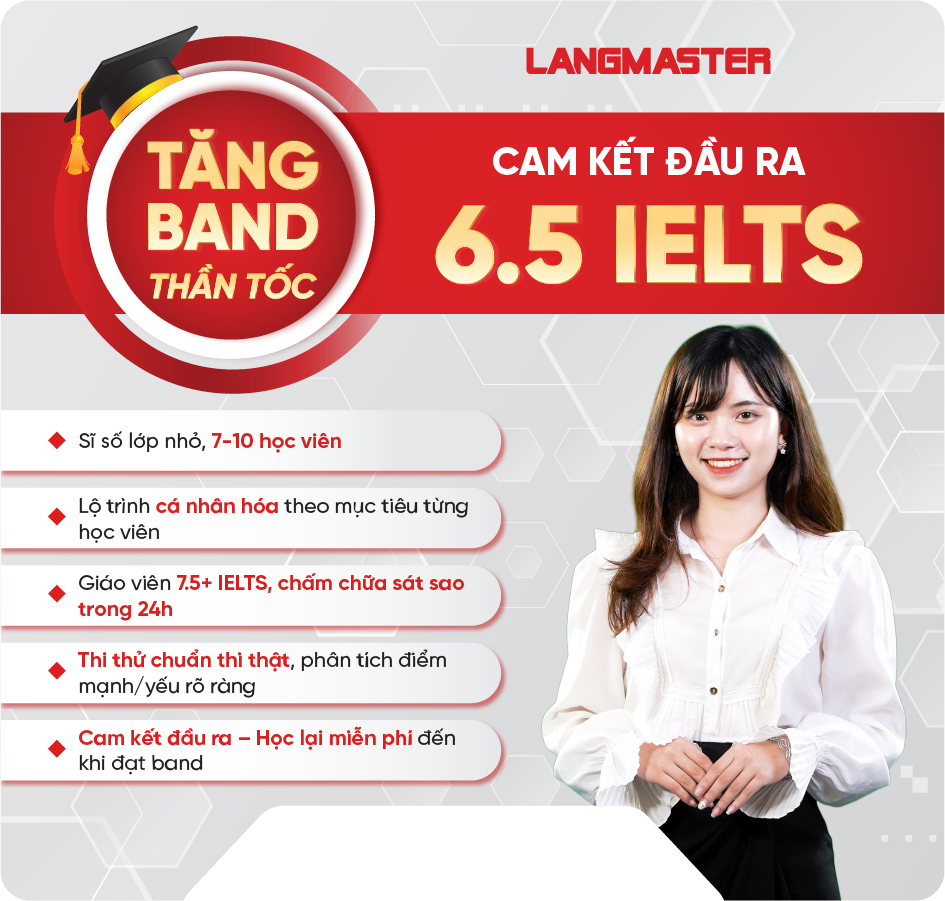
Lớp học được tổ chức theo mô hình sĩ số nhỏ chỉ từ 7 đến 10 học viên. Nhờ vậy, bạn được tương tác trực tiếp với giảng viên và được chữa bài ngay trong buổi học. Điều này giúp giải quyết nỗi lo phổ biến của nhiều bạn khi chọn lớp IELTS đông: giáo viên khó theo sát và khó nắm được sự tiến bộ của từng người.

Đội ngũ giảng viên tại Langmaster đều sở hữu IELTS 7.5 trở lên và được đào tạo bài bản về phương pháp giảng dạy. Không chỉ nắm chắc kiến thức, thầy cô còn theo dõi sát sao tiến độ của từng học viên và duy trì quy trình chấm chữa bài trong vòng 24 giờ. Nhờ đó, bạn luôn biết rõ lỗi sai, định hướng cách cải thiện và theo dõi được sự tiến bộ của bản thân.

Lộ trình học tại Langmaster được cá nhân hóa theo mục tiêu của từng học viên. Trước khi xếp lớp, bạn sẽ làm bài kiểm tra đầu vào đủ bốn kỹ năng để xác định trình độ chính xác. Từ kết quả này, bạn được xếp lớp phù hợp và nhận bài tập phân tầng theo năng lực. Hàng tháng, bạn sẽ nhận báo cáo học tập cá nhân với nhận xét chi tiết từ giảng viên về điểm mạnh và điểm còn hạn chế.

Langmaster cam kết đầu ra bằng văn bản cho từng khóa học. Nếu chưa đạt band điểm đã cam kết, bạn sẽ được học lại miễn phí cho đến khi đạt mục tiêu. Đây chính là yếu tố giúp người học yên tâm, dù học online nhưng vẫn được bảo đảm chất lượng như khi học trực tiếp.

Các buổi học online được thiết kế linh hoạt, giúp bạn tiết kiệm thời gian di chuyển và có thể xem lại bài giảng bất cứ lúc nào. Trong lớp, giảng viên tương tác liên tục, gọi tên từng học viên và triển khai bài tập thực hành ngay trong buổi học để duy trì động lực. Ngoài ra, bạn còn có cơ hội tham gia các buổi coaching 1–1 để nhận hướng dẫn chuyên sâu phù hợp với mục tiêu cá nhân.

Hiện Langmaster đang mở chương trình học thử miễn phí. Bạn có thể đăng ký ngay hôm nay để trải nghiệm lớp học chất lượng và bắt đầu hành trình chinh phục IELTS một cách tự tin.

Học tiếng Anh Langmaster

Học tiếng Anh Langmaster

Langmaster là hệ sinh thái đào tạo tiếng Anh toàn diện với 16+ năm uy tín, bao gồm các chương trình: Tiếng Anh giao tiếp, Luyện thi IELTS và tiếng Anh trẻ em. 800.000+ học viên trên toàn cầu, 95% học viên đạt mục tiêu đầu ra.

Nội Dung Hot

KHOÁ HỌC TRỰC TUYẾN 1 KÈM 1

KHÓA TIẾNG ANH GIAO TIẾP 1 KÈM 1

  • Học và trao đổi trực tiếp 1 thầy 1 trò.
  • Giao tiếp liên tục, sửa lỗi kịp thời, bù đắp lỗ hổng ngay lập tức.
  • Lộ trình học được thiết kế riêng cho từng học viên.
  • Dựa trên mục tiêu, đặc thù từng ngành việc của học viên.
  • Học mọi lúc mọi nơi, thời gian linh hoạt.

Chi tiết

khóa ielts online

KHÓA HỌC IELTS ONLINE

  • Sĩ số lớp nhỏ (7-10 học viên), đảm bảo học viên được quan tâm đồng đều, sát sao.
  • Giáo viên 7.5+ IELTS, chấm chữa bài trong vòng 24h.
  • Lộ trình cá nhân hóa, coaching 1-1 cùng chuyên gia.
  • Thi thử chuẩn thi thật, phân tích điểm mạnh - yếu rõ ràng.
  • Cam kết đầu ra, học lại miễn phí.

Chi tiết

null

KHÓA TIẾNG ANH TRẺ EM

  • Giáo trình Cambridge kết hợp với Sách giáo khoa của Bộ GD&ĐT hiện hành
  • 100% giáo viên đạt chứng chỉ quốc tế IELTS 7.0+/TOEIC 900+
  • X3 hiệu quả với các Phương pháp giảng dạy hiện đại
  • Lộ trình học cá nhân hóa, con được quan tâm sát sao và phát triển toàn diện 4 kỹ năng

Chi tiết


Bài viết khác